Mackenzie Day

Mackenzie Day (daym@epss.ucla.edu) is an Associate Professor at UCLA who studies how wind moves sediment and shapes landscapes on Earth and other planetary bodies. She leads the GALE Lab, where fieldwork, laboratory experiments, numerical modeling, and remote sensing are used together to investigate how dunes form, evolve, and are preserved in the geologic record.
Her group studies active dune fields in Death Valley and Jurassic aeolian sandstones on the Colorado Plateau to connect modern processes with ancient environments. Day also applies insights from terrestrial systems to interpret planetary surfaces, where dune-like bedforms have been identified on Venus, Mars, Titan, and several other worlds. By linking modern and ancient, terrestrial and planetary examples, her research seeks to understand the fundamental physics that govern wind-driven sedimentary systems across the Solar System.
Full CV (updated October 2025): MDay_CV_2025
List of publications and abstracts: Google Scholar
Archived data and supplementary material: GitHub
Recent Research Highlights
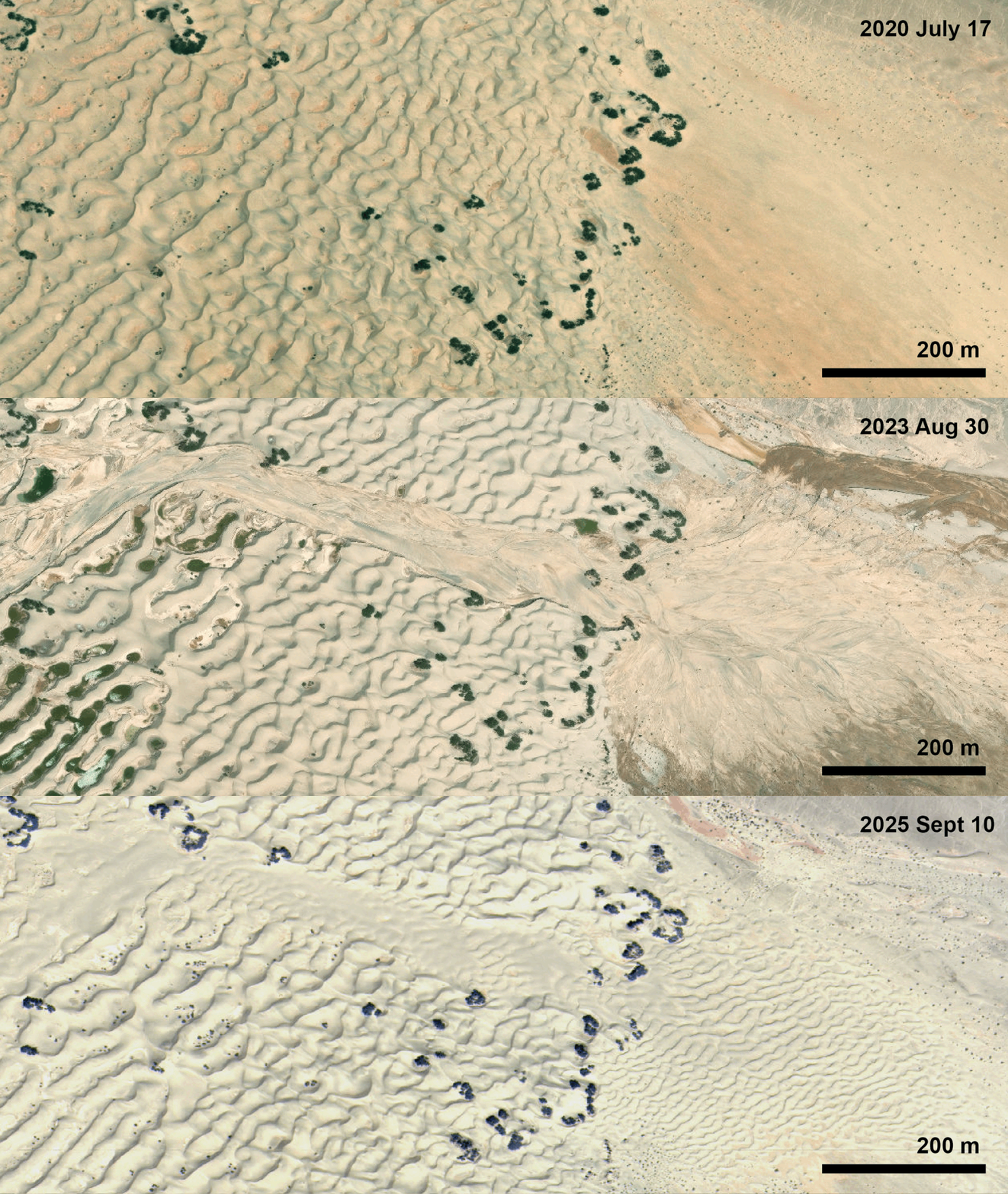
Fluvial-aeolian interactions and landscape recovery post Hurricane Hilary
In 2023 record-breaking rains caused widespread flooding in Death Valley, creating ponds of standing water between dunes and carving a channel through the Mesquite Flats dune field (right). This project follows the aeolian-fluvial landscape interactions in the wake of this extreme event and studies how the landscape recovers over time.
Preserved dunes on Mars uncovered by aeolian abrasion
Dunes are a common sight on Mars today and have been present on the surface for billions of years. By comparing preserved, ancient dunes on Mars (A) with their modern counterparts (B) we can interrogate the paleo-environmental conditions, just as we would with ancient aeolian sandstones on Earth.
For more details and the full figure caption see Hunt et al. (2022).

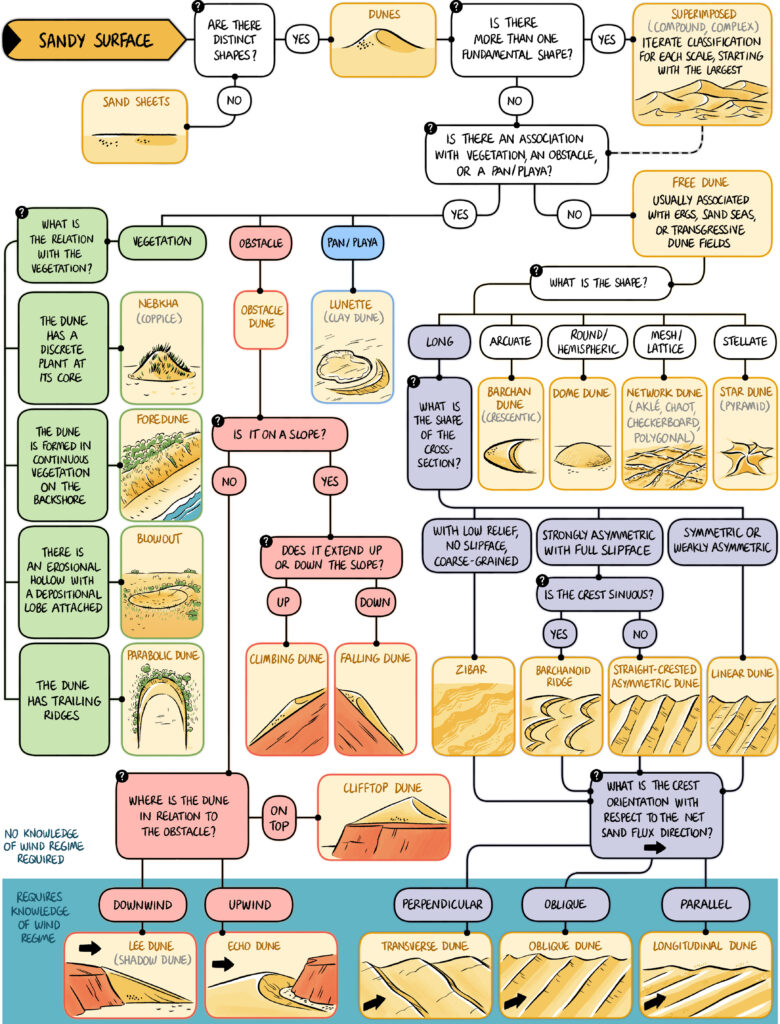
An updated dune classification guide
Over the last half-century, aeolian science has evolved its understanding of how dunes form, but the terminology for classification was woefully behind. Duplicative morphological names and misleading or overly complex terminology create a barrier to continued research in the field. This project included over a dozen aeolian scientists in a community effort to modernize dune classification and streamline how we as a community talk about dunes for future work.
Three classification flow charts provide an easy guide for new entrants to the study of aeolian dunes. For more information and a review of aeolian geology see:
Du Pont, S. C., Rubin, D. M., Narteau, C., Lapôtre, M. G., Day, M., Claudin, P., … & Wiggs, G. F. (2024). Complementary classifications of aeolian dunes based on morphology, dynamics, and fluid mechanics. Earth-Science Reviews, 255, 104772. https://www.sciencedirect.com/science/article/pii/S0012825224000990?via%3Dihub