

Wind Tunnel
The Sediment Transport Wind Tunnel at UCLA is uniquely designed to study the interactions between wind planetary surfaces. Including a subsiding section to study how the geologic record forms, the wind tunnel’s accessories allow for the study of sediment transport, deposition, erosion, bedform formation, and much more. Ongoing projects focus on questions for both Earth and Mars. We strategically use a range of materials to study transport with the eventual goal of understanding wind-sand interactions in arbitrary fluid-gravity conditions.
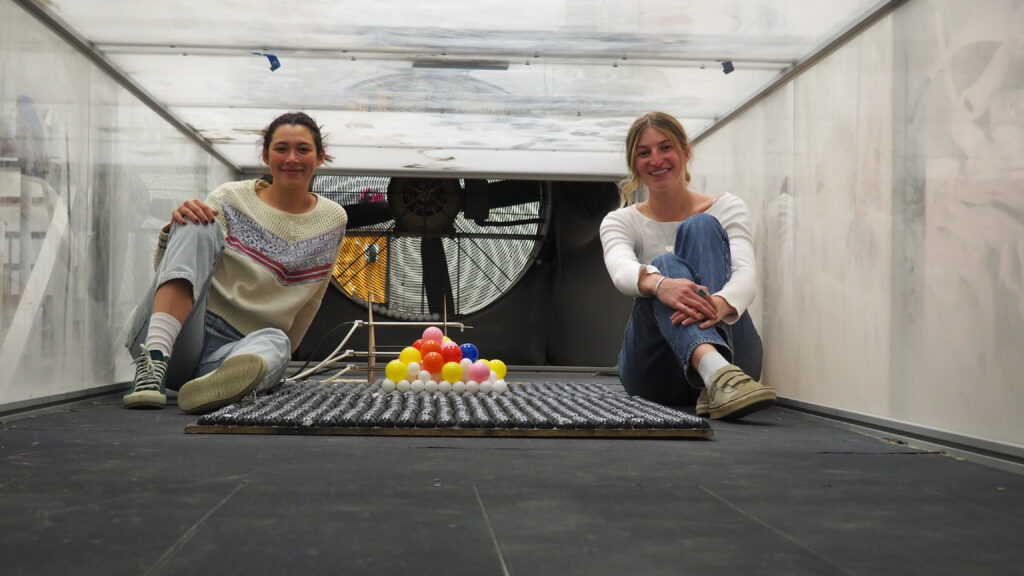
Research opportunities in the wind tunnel have led many undergraduate students at UCLA to pursue graduate careers in Earth Science. Experiments range from studying how plants trap aeolian sand to how low-density spheres saltate across rough terrain.
The open-plan wind tunnel is 7 m long, 2 m wide, and 1 m tall with a top operating wind speed of ~ 13 m/s. Cameras and monitoring equipment mounted overhead and on the tunnel sides support a central rotating test section and lowerable interior basin.

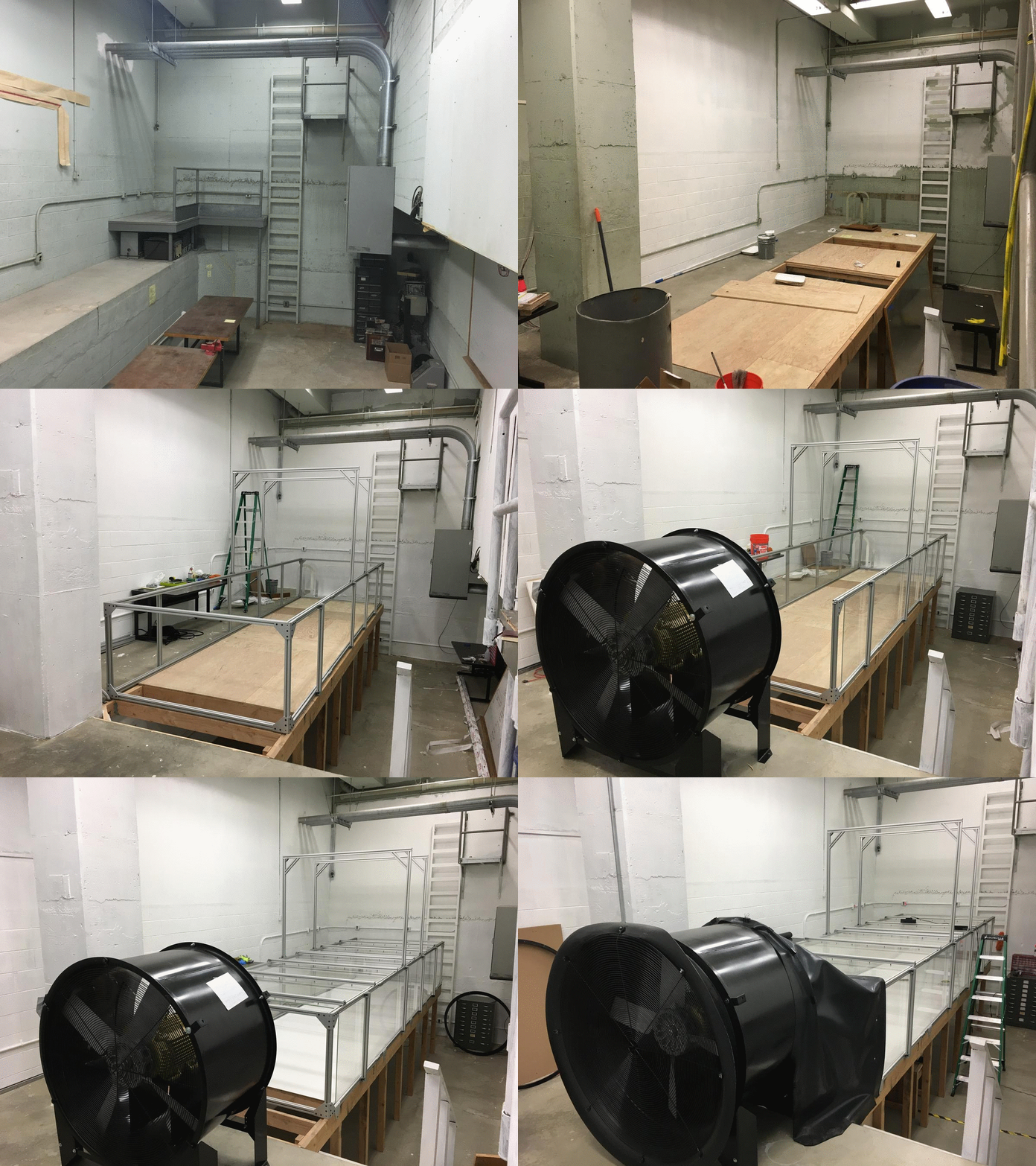
The wind tunnel was built in 2018 with the help of many students and staff members in the historic “pool room” of the Geology building. Many thanks to many helpful hands!
Recent Research from the Wind Tunnel
Day, M., Archbold, A., Sneed, J., & Stack, K. “Aeolian Bedform Shielding: How Transverse Aeolian Ridges Control Periodic Bedrock Ridge formation on Mars”. 56th Lunar and Planetary Science Conference (2025), 3072, 3009. https://www.hou.usra.edu/meetings/dunes2025/pdf/3009.pdf
Bretzfelder, J. and M. Day, “Wind tunnel analog for aeolian sediment motion under planetary conditions,” 54th Lunar and Planetary Science Conference (2023), https://www.hou.usra.edu/meetings/lpsc2023/pdf/2881.pdf
Sneed, J., M. Day, K. Stack, and A. Fraeman, “Experimental Hypothesis Testing of the Origins of Periodic Bedrock Ridges,” 6th International Planetary Dunes Workshop (2020), #3040. Virtual meeting due to COVID-19. https://www.hou.usra.edu/meetings/dunes2020/pdf/3040.pdf