

Atmosphere-Interior Interactions:
Atmospheric escape:
Re-defining Interiors and Atmospheres of Sub-Neptunes
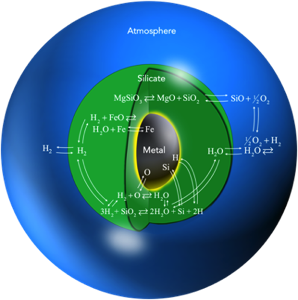
Exoplanet interiors in the past have been modeled as discrete layers consisting of a core, mantle and atmosphere that do not chemically interact with one another. However, this is a very poor approximation, given that the interior temperatures of most Sub-Neptune exoplanets, similar to Uranus and Neptune, are expected to still exceed several thousand degrees Kelvin today. Our group has been one of leaders in the field of connecting the hydrogen-dominated atmospheres with their underlying magma oceans (Schlichting & Young 2022). Unsurprisingly, allowing for this interaction leads to many important phenomena that effect an exoplanet’s accretion, evolution and atmospheric loss history.
The mass of Neptunes is dominated by their rocky interiors. As a result, their silicate reservoir can dictate much of their physics and chemistry causing composition and structural changes in their interiors and envelopes, and over time as they evolve.
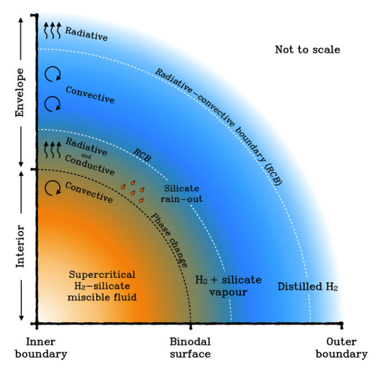
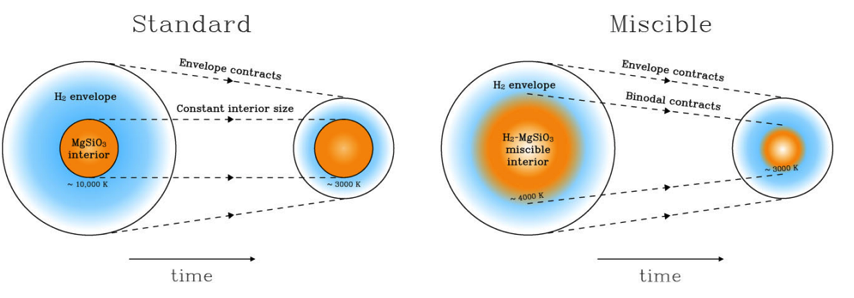
A key phenomenon that remains under-explored in the context of sub-Neptunes is that of miscibility. Silicate and hydrogen are miscible above roughly 4000K at pressures relevant to sub-Neptune interiors. Using the silicate-hydrogen phase diagram, we have, for the first time, self-consistently coupled the physics and chemistry to determine the radial extent of the fully miscible interiors (Rogers, Young & Schlichting 2025). Above this region lies the envelope, where hydrogen and silicates are immiscible and exist in both gaseous and melt phases. We suggest that the binodal surface, representing a phase transition, provides a physically/chemically defined boundary that separates a planet's 'interior' and 'envelope'. Our evolving coupled interior-envelope structure models for sub-Neptunes show that young sub-Neptunes can store several tens of per cent of their hydrogen mass within their interiors. Gravitational contraction and thermal evolution lead to hydrogen exsolving from the interior into the envelope over time slowing the contraction. After Gyrs of evolution, most hydrogen has exsolved, and the radii of miscible and immiscible models converge, but the internal distribution of hydrogen and silicates remains distinct, with some hydrogen retaining in the interior.
Currently we are extending this work to derive testable predictions such that we can determine the prevalence of sub-Neptune with miscible interiors in the observed exoplanet population.
Figure 6: Comparison of two planetary-interior-models: a standard planet with a non-interacting silicate interior and hydrogen envelope, and a miscible planet where hydrogen and silicates are shared between interior and atmosphere. In the standard model, radius evolution is driven mainly by cooling and contraction of the hydrogen envelope. In the miscible case, the binodal boundary contracts over time, the interior releases hydrogen into the envelope, and as a result, the planet's radius contracts slower over time (Rogers, Young & Schlichting 2025).
Figure 5: A schematic for the new radial structure of sub-Neptunes. The “interior” is defined as the region inside the binodal surface. The region above the binodal is defined as the “envelope”. The silicate vapor introduces a mean molecular weight gradient in the envelope, but rains out higher up in the atmosphere.
The research of our lab is driven by the desire to understand planet formation and evolution in our own Solar system and in exoplanet systems. Our research over the last few years has been focused on super-Earths and sub-Neptunes, which are the most abundant planets in our galaxy discovered to date. Super-Earths and Sub-Neptunes typically reside well inside the orbit of Mercury around their respective host stars. This new class of planets is unlike anything found in our own Solar System.
Our lab has made contributions to our understanding of atmospheric accretion (e.g. Ginzburg, Schlichting, Sari 2016) and loss during the formation of super-Earths and sub-Neptunes (e.g. Ginzburg, Schlichting, Sari 2018, Gupta & Schlichting 2019, Biersteker & Schlichting 2020), their orbital and resonance configurations and evolution (Goldreich & Schlichting 2014), and, most recently, their chemical composition and interior structure (e.g. Schlichting & Young 2022, Rogers, Young & Schlichting 2025).
A sample of our current research focus is outlined below:
For example, our lab showed that silicate vapor in a hydrogen-dominated atmospheres acts as a condensable, causing mean molecular weight gradients that can inhibit convection, which alters a planet's thermal evolution (Misener & Schlichting 2023).
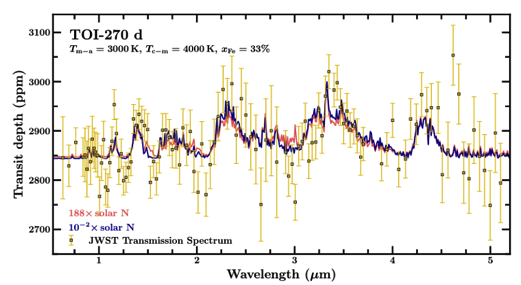
We also showed that the chemical composition of sub-Neptune atmospheres can be used as probes of their interiors, which contain more than ~95% of the planet's total mass. This particular exciting since observationally one can only probe their upper atmospheres (see Figure 2).
Another interesting finding from our lab has been that significant endogenous water is produced by magma-hydrogen interactions alone, without the need to accrete ice-rich material (Schlichting & Young 2022). In a separate study we showed that even Earth's water may also have originated this way (Young et al., Nature 2023).
Figure 2: Magma Ocean Interactions Can Explain JWST Observations of the Sub-Neptune TOI-270 d. Gold squares with error bars show the observed JWST spectrum from Benneke et al. (2024). The pink and blue
lines show forward modeled spectra assuming the upper atmospheric composition from coupled magma–atmosphere models. The pink line shows a case where nitrogen is enhanced in line with the carbon and oxygen enhancement found by the magma–atmosphere model. The blue line shows a case where nitrogen is depleted to 10−2 × solar abundance, in line with expectations of nitrogen depletion from magma–atmosphere interactions. Figure from Nixon et al. 2025.
Figure 1: Simplified depiction of the hydrogen reaction network for a planet with an hyrdogen rich primary atmosphere. Redox chemistry leads to water formation in the atmosphere and light elements in the metal core.
Atmospheric Escape:
The PEARL is interested in a whole range of atmospheric escape problems, ranging from atmospheric loss from giant impacts and planetesimal collisions to hydrodynamic escape powered by core-powered mass loss and photo-evaporation. Most recently we have been focused on modeling hydrodynamic escape in the small, close-in exoplanet population. Specifically, the formation of super-Earths from their sub-Neptune progenitors, and the transition from core-powered mass-loss to photo-evaporation as a planet evolves from birth to its current observed state.
In addition, using AIOLOS, a hydrodynamic radiative transfer code, we have been investigating how mass-loss changes the atmospheric composition of sub-Neptunes. This offers an additional observational test to probe the importance of atmospheric escape in shaping the small exoplanet population and it also informs the initial atmospheric compositions of super-Earths that form via mass-loss from their sub-Neptune progenitors.
Our lab is also involved in directly observing atmospheric escape in exoplanet systems using, for example, the Keck telescopes in Hawaii and the Hubble Space Telescope.
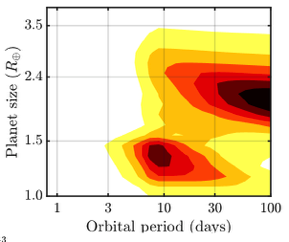
Figure 3: Modeling the small, close-in exoplanet population with atmospheric escape. These calculations started out with a single planet population consisting of rocky cores and hydrogen envelopes that over time evolved into two: super-Earths (smaller, rocky planets that lost their hydrogen envelopes) and sub-Neptunes (larger planets that retained some of their primordial atmospheres). Results from hydrodynamic atmospheric escape models match the observed exoplanet population well. Figure from Gupta & Schlichting (2020).
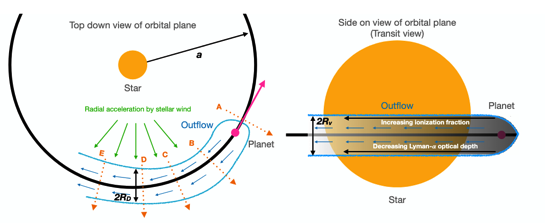
Figure 4: A schematic diagram of the outflowing gas shaped into a planetary tail, and the origin of a Lyman-alpha or He-triplet transit. The left and right panel show the system geometry when observed top-down, or side-on, respectively. Figure from Owen et al. (2023).